
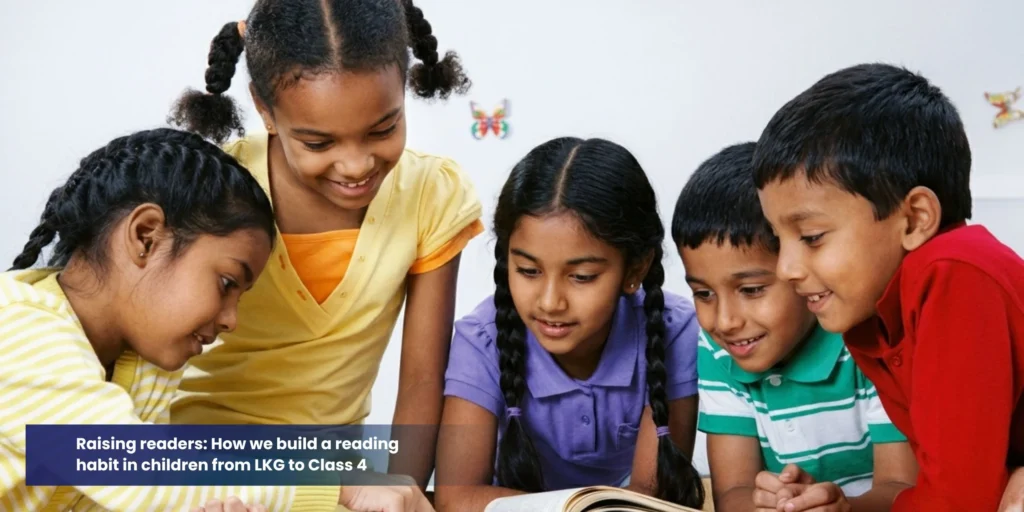
Every great reader once sat on a carpet, listening to someone else read a story. That simple moment is where a lifelong habit begins. A reading habit in children shapes how they speak and learn long after they leave primary school. At MauryanHigh, we start building that habit in LKG and keep nurturing it carefully until Class 4.
Why is a reading habit in children so important?
Children who read regularly understand lessons faster, speak more clearly and think more independently. Reading touches almost every subject they will study.
A child who reads well can follow a science experiment, solve a maths word problem and enjoy a history chapter. A child who struggles with reading often finds all three harder. In our experience, the gap between confident readers and reluctant readers grows wider each year. That is why the early years matter so much.
Well-read children also tend to speak up more. They have more words and ideas to draw on. As a result, they often feel more confident in class discussions and, later, debates.
What does reading build?
Reading builds far more than vocabulary. Here is how a regular reading habit supports a child’s growth:
Skill | How reading builds it |
Communication | Children learn new words and how to express ideas clearly |
Comprehension | Following a story trains children to understand what they read |
Imagination | Stories invite children to picture places and people they have never seen |
Problem solving | Characters face challenges, and children think about how to solve them |
Critical thinking | Children ask why things happen and form their own opinions |
Writing | Good readers absorb sentence patterns and write with more confidence |
Did you know? India’s National Education Policy 2020 calls the goal of foundational literacy and numeracy for every child an urgent national mission.
How does the reading habit grow from LKG to Class 4?
The habit grows in stages, from listening to stories to reading alone. Each stage prepares a child for the next.
Listening to stories in LKG and UKG
Young children first fall in love with stories by hearing them. Pictures, voices and repetition help them connect sounds with meaning.
Early reading in Classes 1 and 2
Children begin reading short sentences and simple books. Small successes, like reading a page alone, build real pride.
Independent reading in Classes 3 and 4
Students start choosing books for themselves and reading longer stories. They also begin talking about what they read and why they liked it.
How do we nurture readers at MauryanHigh?
We build the habit through read-aloud sessions for young children and regular library periods from LKG to Class 4. Small classes make sure every child gets attention.
Our teachers read aloud to our youngest students. Listening to a story read with expression helps children enjoy books, hear new words and learn to listen before they read on their own. In our experience, children who are read to often ask for “one more story”, which is exactly the habit we want to grow.
Students also visit our spacious library during regular library periods. They choose books freely and learn that reading can be a pleasure, not just a task. With classes limited to 30 students, our teachers notice who needs encouragement and who is ready for harder books. You can read more about these years in our junior school section.
How can parents build the reading habit at home?
School and home should work together, and a few simple habits can make a big difference.
- Read the text aloud together for 15 minutes each day, even when your child is able to read by themselves.
- Make sure that books are within easy reach both in the living room and in the bedroom.
- Let your child select a few of the books, even if they end up choosing some of their favourites.
- Such open questions as “What do you think happens next?” should be posed.
- Go to a library or bookstore together on weekends.
Children copy what they see. When they watch parents reading, they are far more likely to pick up a book themselves.
Start your child’s reading story at MauryanHigh
Parents comparing good schools in Vadodara often look at facilities and results first. Yet a strong reading habit in children may be one of the most valuable gifts any school can offer. As an English medium school in Vadodara, we give reading a special place from the very first year.
We would like to invite those children who are going from LKG to Class 4 in the 2027–28 academic year to come and see MauryanHigh at its Sigma Campus on Ajwa Nimeta Road, Vadodara 390019. You should take the opportunity to look around our library and classrooms. Our office is open from 8 a.m. to 5 p.m., from Monday through Saturday. You can reach us by telephone at 9099995360 or 02668 267155, or you may choose to go through our admissions process.
FAQs
1. Why is reading aloud important for young children?
Reading aloud to young children helps them to enjoy stories, to hear new words and to learn how to listen carefully. It develops their vocabulary and concentration before they are able to read by themselves, and makes books seem warm and familiar to them from an early age.
2. At what age should a child start building a reading habit?
The habit can start as early as LKG, through listening to stories read aloud. Children then move to early reading in Classes 1 and 2, and independent reading by Classes 3 and 4.
3. What are the benefits of reading for kids?
Reading builds communication, comprehension, imagination, problem-solving, critical thinking and writing skills. Well-read children also tend to feel more confident speaking in class and taking part in discussions and debates.
4. How does MauryanHigh build a reading habit in young students?
Teachers at MauryanHigh read aloud to the youngest students, and children from LKG to Class 4 attend regular library periods in the school’s spacious library. Small classes of 30 help teachers guide every reader.
5. How can parents encourage reading at home?
Read aloud together for 15 minutes daily, keep books within easy reach and let children choose some books themselves. Asking open questions about stories and reading in front of children also builds the habit.